FOOD SAFETY, MISREPRESENTATION AND HALAL INTEGRITY: A CASE STUDY OF PUBLIC PROSECUTOR V WEE MEE INDUSTRIES CO SDN BHD (1986) 1 MLJ 505
DOI:
https://doi.org/10.33102/inslae-proceedings.300Keywords:
Halal Forensics, Food Fraud, False Trade Description, Halal Integrity, Consumer Protection, Food Law, Forensic ScienceAbstract
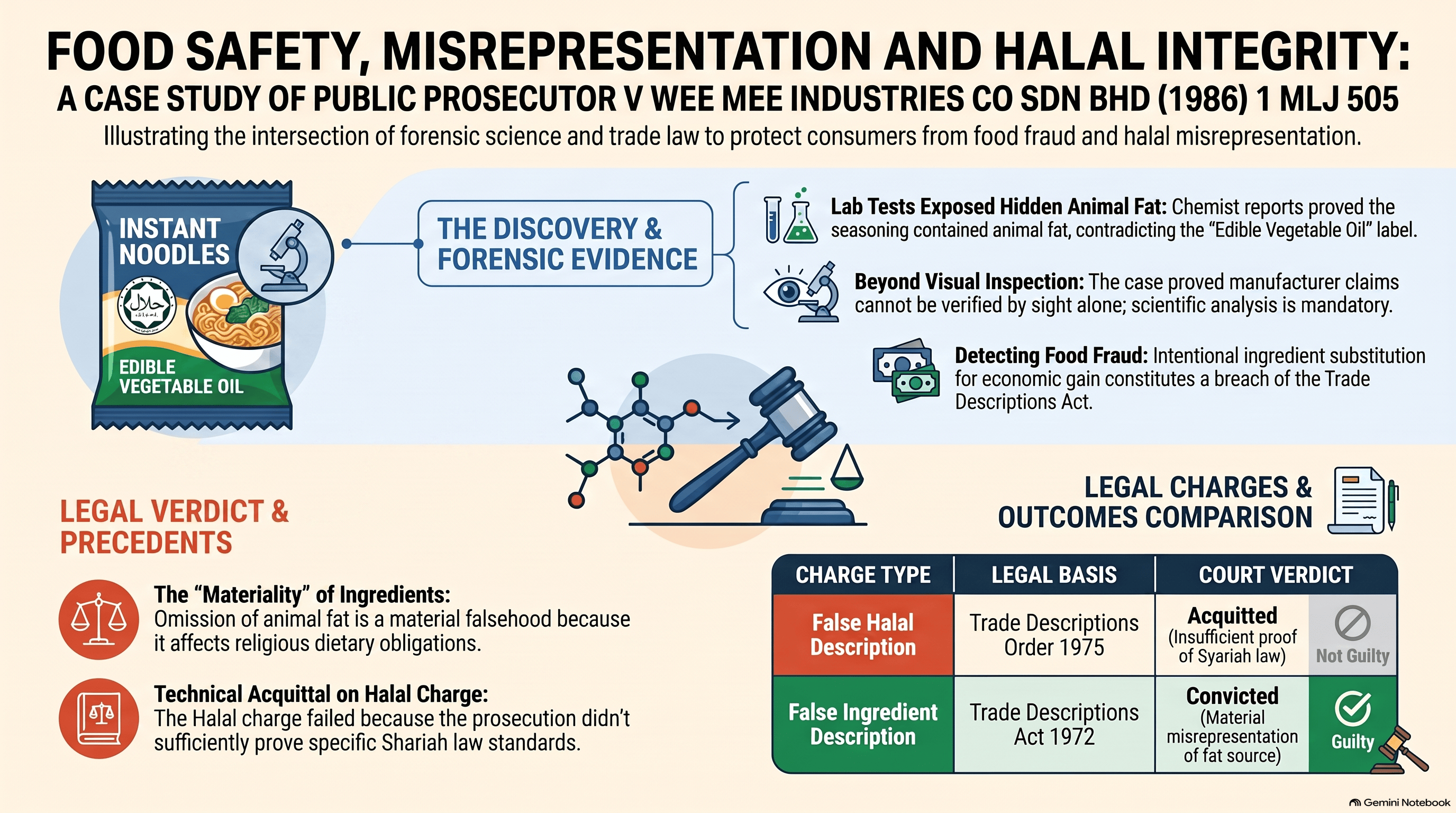
The case of Public Prosecutor v Wee Mee Industries Co Sdn Bhd (1986) 1 MLJ 505 is widely recognised as one of the most significant judicial decisions concerning food integrity, consumer protection and halal regulation in Malaysia. The case occurred due to the marketing of instant noodles produced by Wee Mee Industries, marked as "Halal" and "Edible Vegetable Oil", however, the scientific analysis showed that the seasoning powder contained animal fats. The case brought up the legal questions regarding the interpretation of false trade descriptions, the importance of scientific analysis in proving the case related to food crimes and the way how religious concepts like halal could be enforced via secular law. While the Respondent was acquitted of the charge related to the false use of the halal description because of weak proof regarding the applicability of Hukum Syarak in Sarawak, the conviction for making a false description of the ingredients of the food was affirmed. Thus, this judgment set the precedent regarding the interpretation of materially false descriptions and showed the key importance of forensic science in detecting food frauds.
Downloads
References
Ahmad, F., Hussein, M. Z., Roslan, N. F., Husny, Z. J., Rahim, A. N. S., & Ramzi, M. (2016). A study on application of false trade description towards halal food products. International Journal of Supply Chain Management, 5(2), 127–130.
Alam, A., Fuadati, A. R., Fathma, A., Nordin, N., & Ullah, I. (2025). Halal awareness in contemporary Muslim societies: A systematic review of Scopus-indexed studies. Journal of Fatwa Management and Research, 30(3), 215–238.
Jeffrey, E. (2026). HALAL certification Malaysia: Complete guide to JAKIM certification process.
Malaysia. (1972). Akta Perihal Dagangan 1972 (Akta 87).
Malaysia. (1975). Trade Descriptions (Use of Expression “Halal”) Order 1975.
Mortas, M., Awad, N., & Ayvaz, H. (2022). Adulteration detection technologies used for halal/kosher food products: An overview. Discover Food, 2(1), Artikel 15. https://doi.org/10.1007/s44187-022-00015-7
Muhamad Nazari, N. N. A., Abu Bakar, E., & Muhammad Arif, A. M. (2023). Consumer protection against the false description of halal in e-commerce. UUM Journal of Legal Studies, 14(2), 657–675. https://doi.org/10.32890/uumjls2023.14.2.10
Public Prosecutor v Wee Mee Industries Co Sdn Bhd [1986] 1 MLJ 505.
Usman, I., Sana, S., Afzaal, M., Imran, A., Saeed, F., Ahmed, A., Shah, Y. A., Munir, M., Ateeq, H., Afzal, A., Azam, I., Ejaz, A., Nayik, G. A., & Khan, M. R. (2023). Advances and challenges in conventional and modern techniques for halal food authentication: A review. Food Science & Nutrition, 12(3), 1430–1443. https://doi.org/10.1002/fsn3.3870
Wu, L., Tang, H., Dai, X., Chen, X., & Zhang, J. (2024). Prevention of food fraud and fraud emulation among companies in the supply chain based on a social co-governance framework. Heliyon, 10(9), Artikel e30340. https://doi.org/10.1016/j.heliyon.2024.e30340
Zakaria, Z., & Ismail, S. Z. (2015). The development of regulations concerning halal through Trade Description Act 2011 in Malaysia. Jurnal Syariah, 23(2), 189–216.
Downloads
Published
Conference Proceedings Volume
Section
How to Cite