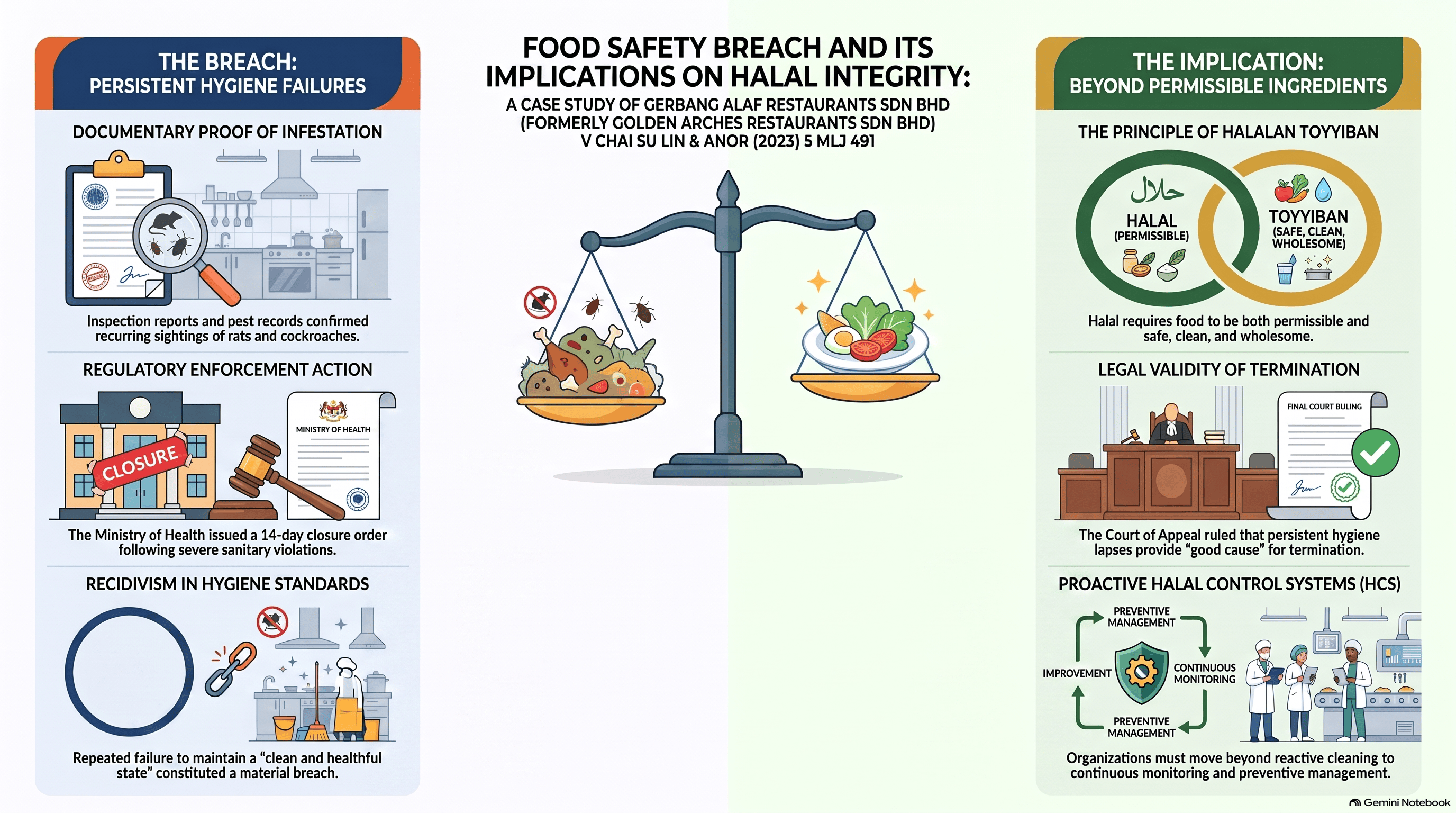
FOOD SAFETY BREACH AND ITS IMPLICATIONS ON HALAL INTEGRITY: A CASE STUDY OF GERBANG ALAF RESTAURANTS SDN BHD (FORMERLY GOLDEN ARCHES RESTAURANTS SDN BHD) V CHAI SU LIN & ANOR (2023) 5 MLJ 491
DOI:
https://doi.org/10.33102/inslae-proceedings.302الكلمات المفتاحية:
Halal Forensics، Contractual Dispute، Burden of Proof، Total Failure of Consideration، Halal Governance، Project Management، Documentary Evidenceالملخص
Food safety is a crucial aspect of halal integrity, for in Islam, the halal must also be safe, clean, and wholesome so it can be eaten. This study uses case analysis on Gerbang Alaf Restaurants Sdn Bhd (formerly Golden Arches Restaurants Sdn Bhd) v Chai Su Lin & Anor (2023) 5 MLJ 491 to discuss the correlation between the breach of food safety and the integrity of the halal. The study employs doctrinal legal research and a case study analysis with the court judgment, the legislation, halal standards and literature used to analyze the case. The findings indicated that there was a breach of food safety as much as repeated hygiene failures which led to regulatory enforcement and eventually the termination of the franchise agreement which included rat droppings and cockroach infestations. Documentary evidence, including inspection reports, pest control records, health authority notices, showed the current non-compliances and revealed the shortcomings of the food safety and halal management system implementation from a halal forensic point of view. The study also underscores that food safety issues impact the toyyiban dimension of halal which in turn impacts consumers' confidence and the integrity of halal certified organizations. It concludes that it is necessary to always comply with food safety regulations, as well as be able to implement good Halal Control Systems and to have good hygiene management practices ahead of the game to maintain the halal integrity. The case draws attention to the necessity of establishing a sustainable halal assurance process that incorporates halal principles and food safety to maintain the trust of consumers in the halal industry.
التنزيلات
المراجع
Bonne, K., & Verbeke, W. (2008). Religious values informing halal meat production and the control and delivery of halal credence quality. Agriculture and Human Values, 25(1), 35–47. https://doi.org/10.1007/s10460-007-9076-y
Department of Islamic Development Malaysia. (2020). Manual procedure for Malaysia halal certification (domestic) 2020 (Edisi ke-3). JAKIM.
Gerbang Alaf Restaurants Sdn Bhd (formerly known as Golden Arches Restaurants Sdn Bhd) v Chai Su Lin & Anor [2023] 5 MLJ 491.
Latif, I. A., Mohamed, Z., Sharifuddin, J., Abdullah, A. M., & Ismail, M. M. (2014). A comparative analysis of global halal certification requirements. Journal of Food Products Marketing, 20(S1), 85–101. https://doi.org/10.1080/10454446.2014.921869
Malaysia. (1983). Akta Makanan 1983 (Akta 281).
Malaysia. (1998). Akta Francais 1998 (Akta 590).
Malaysia. (2009). Peraturan-Peraturan Kebersihan Makanan 2009.
Department of Standards Malaysia. (2019). MS 1500:2019 Halal food—General requirements (Edisi ke-3).
Noordin, N., Noor, N. L. M., Hashim, M., & Samicho, Z. (2014). Value chain of halal certification system: A case of the Malaysia halal industry. Procedia - Social and Behavioral Sciences, 121, 79–85. https://doi.org/10.1016/j.sbspro.2014.01.1110
Rahman, A. A., Singhry, H. B., Hanafiah, M. H., & Abdul, M. (2017). Influence of perceived benefits and traceability system on the readiness for Halal Assurance System implementation among food manufacturers. Food Control, 73, 1318–1326. https://doi.org/10.1016/j.foodcont.2016.10.048
Tieman, M. (2011). The application of halal in supply chain management: In-depth interviews. Journal of Islamic Marketing, 2(2), 186–195. https://doi.org/10.1108/17590831111139876
Tieman, M., van der Vorst, J. G. A. J., & Ghazali, M. C. (2012). Principles in halal supply chain management. Journal of Islamic Marketing, 3(3), 217–243. https://doi.org/10.1108/17590831211259726
van der Spiegel, M., van der Fels-Klerx, H. J., Sterrenburg, P., van Ruth, S. M., Scholtens-Toma, I. M. J., & Kok, E. J. (2012). Halal assurance in food supply chains: Verification of halal certificates using risk-based approaches. Food Control, 27(1), 109–119. https://doi.org/10.1016/j.foodcont.2012.03.008
Yaacob, N., & Shuib, M. S. (2015). Halal assurance systems in halal food production: A systematic approach to halal integrity. Journal of Contemporary Islamic Studies, 1(1), 1–16.
Zulfakar, M. H., Jie, F., & Chan, C. (2014). Halal food supply chain integrity: From a literature review to a conceptual framework. International Journal of Productivity and Performance Management, 63(1), 78–98. https://doi.org/10.1108/IJPPM-01-2013-0004
التنزيلات
منشور
إصدار
القسم
كيفية الاقتباس