LEGAL ANALYSIS OF MISREPRESENTATION AND PASSING OFF IN FOOD BRANDING: A CASE REVIEW OF MCCURRY RESTAURANT (KL) SDN BHD V MCDONALDS CORPORATION [2009] 3 MLJ 774
DOI:
https://doi.org/10.33102/inslae-proceedings.301الكلمات المفتاحية:
Passing Off، Misrepresentation، Food Branding، Family of Marks، SME Protectionالملخص
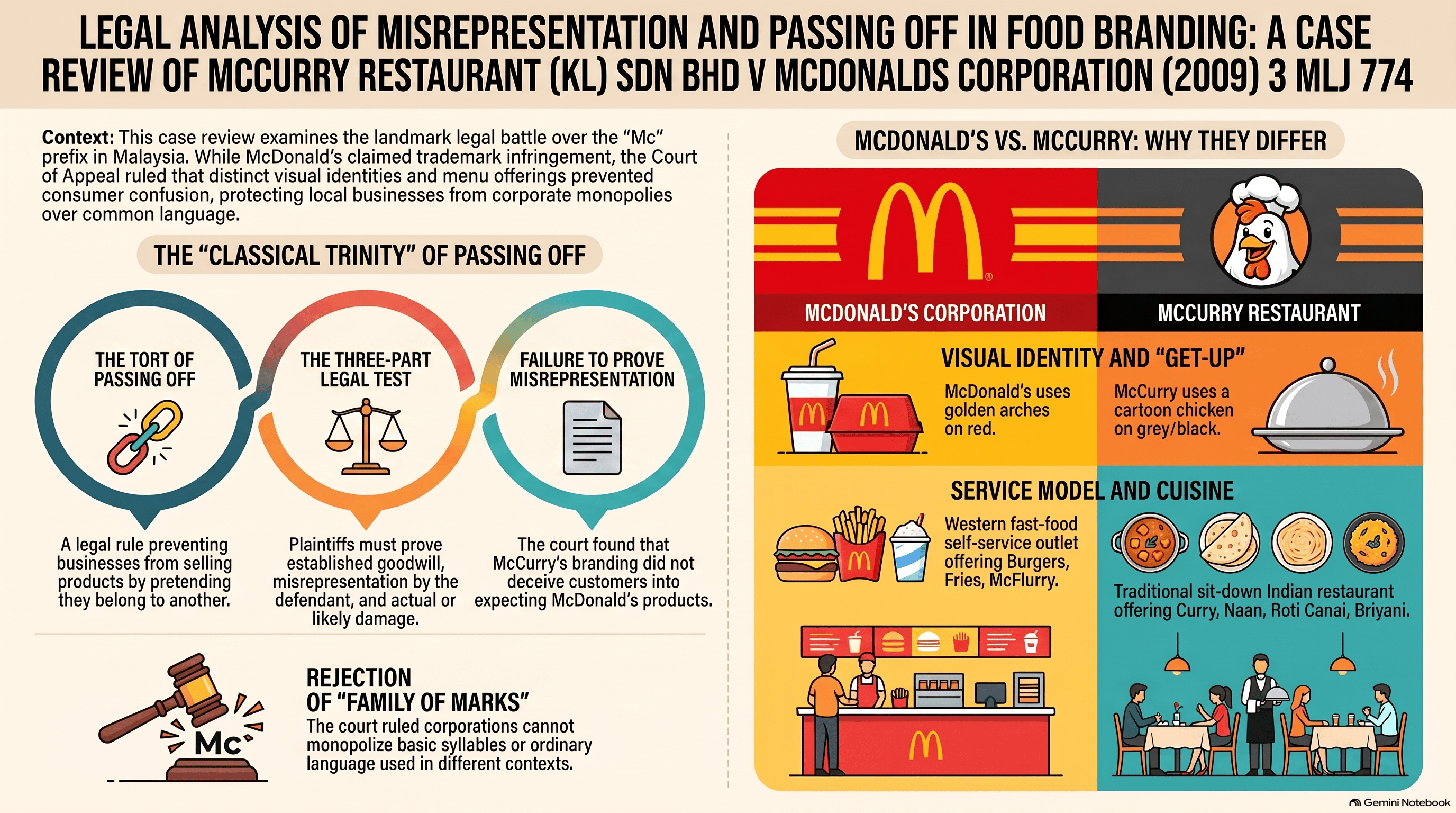
Brand names and visual presentation are very important in the modern food industry to attract consumers and build a strong business identity (Abdul Rahman et al., 2024). This paper provides an academic case review of the famous legal dispute, McCurry Restaurant (KL) Sdn Bhd v McDonalds Corporation [2009] 3 MLJ 774. The main legal issue in this case was the common law tort of passing off. Specifically, the court had to decide if the local restaurant’s use of the prefix “Mc” in its name “McCurry” was a form of misrepresentation that would confuse ordinary customers into thinking the business was linked to McDonald’s global network. Although the High Court originally ruled in favor of McDonald’s, the Court of Appeal reversed the decision, and this was later supported by the Federal Court. This study explores the key legal elements of passing off applied in the case, and explains why the huge differences in the logos, menu items, and dining environments prevented any real customer confusion. In addition, this review discusses why the court rejected the “family of marks” argument and analyzes the positive socio-economic impacts of this judgment in protecting local small and medium enterprises (SMEs) and Halal food brands from unfair corporate intimidation. Ultimately, this case shows that common law courts will not allow big corporations to control simple syllables or parts of speech unless there is clear proof of public deception.
التنزيلات
المراجع
Ahmad, F., Hussein, M. Z., Roslan, N. F., Husny, Z. J., & Rahim, N. S. A. (2016). A study on application of false trade description towards halal food products. International Journal of Supply Chain Management, 5(3), 127–130.
Boey, W. L. (2010). McDonald’s v McCurry: A comment on McDonald losing its trademark battle against McCurry. LoyarBurok Law Journal, 2(1), 15–22.
Ibrahim, I., & Nambiar, M. (2013). What’s in a prefix? A linguistic and legal analysis of the McDonald’s vs McCurry dispute in Malaysia. Pertanika Journal of Social Sciences and Humanities, 21(2), 541–556.
Ismail, R., Yusoff, S. S. A., Isa, S. M., Manap, N. A., & Mokhtar, F. S. (2018). Trader’s liability for false, misleading and deceptive food labeling under Malaysian legislations. International Journal of Business and Society, 19(3), 457–469.
Jaswir, I., Mirghani, M. E. S., Salleh, H. M., Ramli, N., Octavianti, F., & Hendri, R. (2016). An overview of the current analytical methods for halal testing. Journal of Halal Research, 2(1), 1–10.
Malaysia. (2011). Akta Perihal Dagangan 2011 (Akta 730).
McCurry Restaurant (KL) Sdn Bhd v McDonalds Corporation [2009] 3 MLJ 774.
Moscato-Wolter, A. (2011). What is the McLaw in Malaysia? Evaluating trademark prefix monopolies and consumer confusion in McDonald’s Corp. v. McCurry. Akron Intellectual Property Journal, 5(1), 89–114.
Ramli, A. H., & Zakaria, S. (2022). Safeguarding local food enterprises against multinational trademark encroachment: A socio-legal perspective. Journal of Malaysian and International Law, 16(4), 202–221.
Razak, M. A. A., Ramli, M. A., & Adnan, F. (2019). Decision tree for halal food forensics (UBAT-HALFOR) [Kertas kerja]. ResearchGate.
Reckitt & Colman Products Ltd v Borden Inc [1990] 1 All ER 873.
التنزيلات
منشور
إصدار
القسم
كيفية الاقتباس