HALAL FORENSIC ANALYSIS OF NON-COMPLIANCE WITH MINERAL STANDARDS IN MINERAL WATER: A CASE STUDY OF PUBLIC PROSECUTOR V PEK WOEI YI & MALEE MINERAL WATER SDN. BHD. (2022)
DOI:
https://doi.org/10.33102/inslae-proceedings.299الكلمات المفتاحية:
Halal Forensic، Halalan Tayyiban، Food Safety، Mineral Water، Forensic Analysis، Halal Consficationالملخص
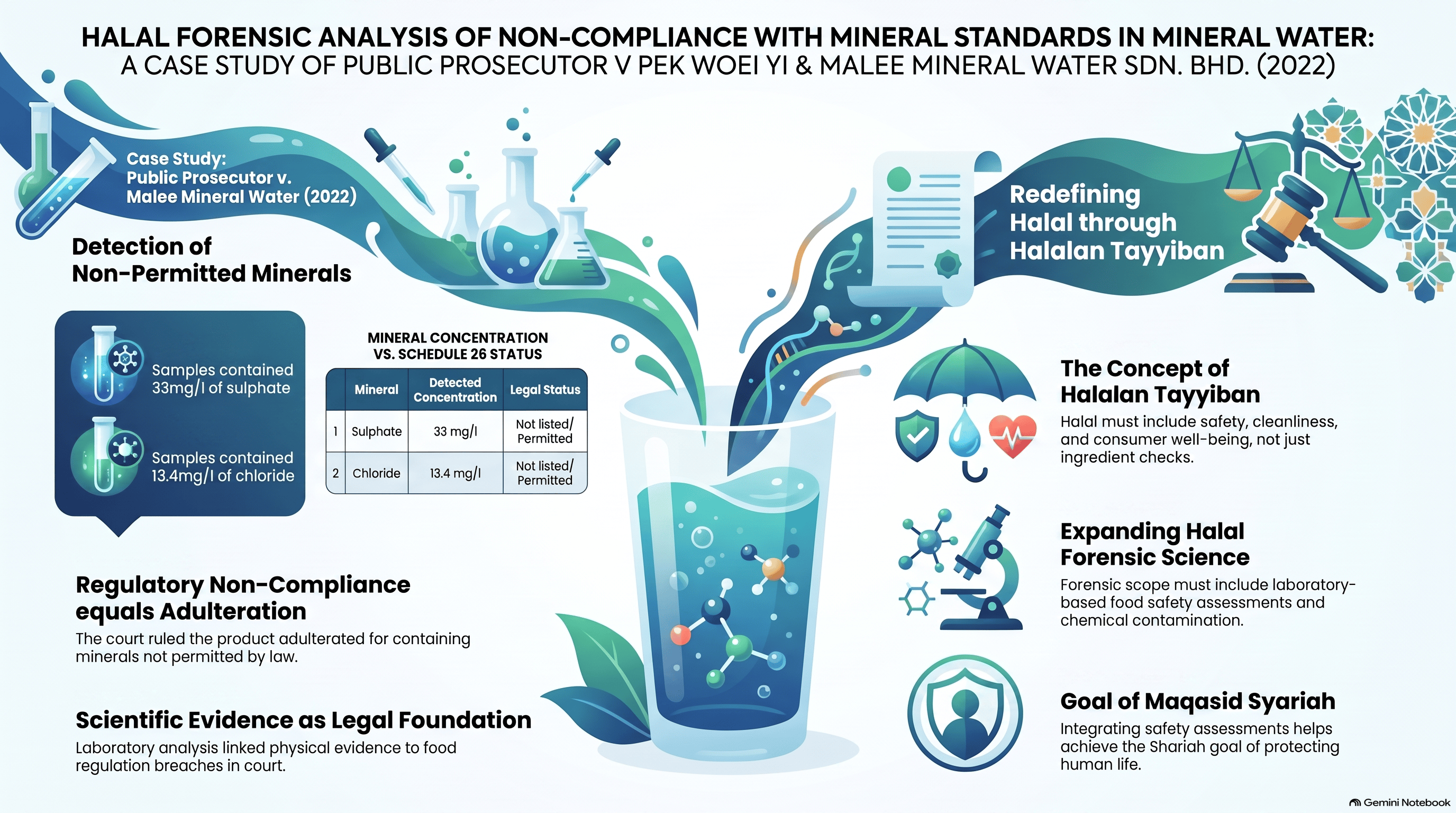
Halal forensic studies have focused primarily on the detection of banned ingredients in food using DNA authentication and chemical detection methods. The utilisation of forensic science, as part of the general idea of halalan tayyiban to assess food safety is seen to have received comparatively less attention. This paper discusses the case of Public Prosecutor v Pek Woei Yi & Malee Mineral Water Sdn. Bhd. (2022) 1 LNS 1111, the Court determined that detection of sulphate and chloride in bottled mineral water constituted a breach that could be remedied by ensuring their concentration in the water is maintained within safe limits, as opposed to being completely eliminated. The research method used is qualitative approach with doctrinal and document analysis methods on the sources of the study, which are the court records, scientific research, and Halal Regulation. The analysis demonstrates that laboratory results can be crucial evidence in a case of regulatory noncompliance, even if the detected substance is a naturally occurring entity and is not likely to cause any adverse health impacts at low levels. The case also exemplifies how scientific evaluation, typically risk assessment, and legal interpretation, typically stressing legal conformance to the current law, diverge. Overall, the case indicates that the halal assurance should not be limited to the verification of food ingredients only, but should also take into account the food safety and quality issues from the halalan tayyiban point of view. Based on this, the paper suggests that the scope of halal forensic science should be expanded to involve laboratory-based food safety parameter assessment process as part of the halal certification process. This could help to increase public trust in halal certification and facilitate the achievement of the Maqasid Syariah which is taken up in this study, namely protecting human well-being.
التنزيلات
المراجع
Ali, M. A. M., Riza, N. S. M., Hamdan, M. N., & Ariffin, M. F. M. (2023). Food safety in halalan tayyiban discourse according to mufassirin. International Journal of Academic Research in Business and Social Sciences, 13(8), 227–237.
Alias, M. A. A., Mohd Jailani, M. R., Wan Ismail, W. A. F., & Baharuddin, A. S. (2024). The integration of five main goals of shariah in the production of science and technology for human well-being. AL-MAQASID: The International Journal of Maqasid Studies and Advanced Islamic Research, 5(1), 1–16. https://doi.org/10.55265/al-maqasid.v5i1.79
Francesco, S., Riccardo, F., Giacomo, V., Marta, R., Federica, M., Fabiani, L., & Macrì, P. G. (2026). Criminal attribution in suspected foodborne listeriosis: A methodological template for pathogen-specific forensic investigation. Forensic Sciences, 6(1), 24. https://doi.org/10.3390/forensicsci6010024
Martuscelli, M., Serio, A., Capezio, O., & Mastrocola, D. (2020). Safety, quality and analytical authentication of ḥalāl meat products, with particular emphasis on Salami: A review. Foods, 9(8), 1111. https://doi.org/10.3390/foods9081111
Mokti, H. A., Kamri, N. A., & Balwi, M. A. W. F. (2023). Tayyiban in halal food production: A systematic literature review. Journal of Islamic Marketing, 15(2), 397–417.
Razaly, M. M., & Zakaria, Z. (2018). The implementation of halal assurance management system in Malaysia’s certified halal slaughter houses and its related issues: A literature review. Journal of Shariah Law Research, 3(1), 105–124.
Saadat, S., Pandya, H., Dey, A., & Rawtani, D. (2022). Food forensics: Techniques for authenticity determination of food products. Forensic Science International, 333, Article 111243.
Sari, D. P., Jaswir, I., & Che Daud, M. R. (2021). Factors affecting the successful implementation of MS1500 by Malaysian halal food industry. International Journal of Halal Research, 3(2), 102–112.
Vaccarezza, M., Vitale, M., Falletta, P., & di Martino, O. (2025). Natural sulfur compounds in mineral waters: Implications for human health and disease (Version 1). Curtin University. https://hdl.handle.net/20.500.11937/99122
Venancio, L. V. L., Farinha, A. S. F., & Gomes, M. T. S. R. (2018). Analysing sulphate and chloride in mineral drinking water by flow injection analysis with a single acoustic wave sensor. Talanta, 189, 65–70.
Yusop, M. H. M., & Bakar, M. F. A. (2020). Review on halal forensic: A focus on DNA-based methods for pork authentication. Food Research, 4(6), 2347–2354.
التنزيلات
منشور
إصدار
القسم
كيفية الاقتباس