THE USE OF RADIO TELESCOPES TO OBSERVE THE NEW LUNAR CRESCENT IN MALAYSIA
Keywords:
new lunar crescent, hilal, radio telescope, observation, Islamic astronomyAbstract
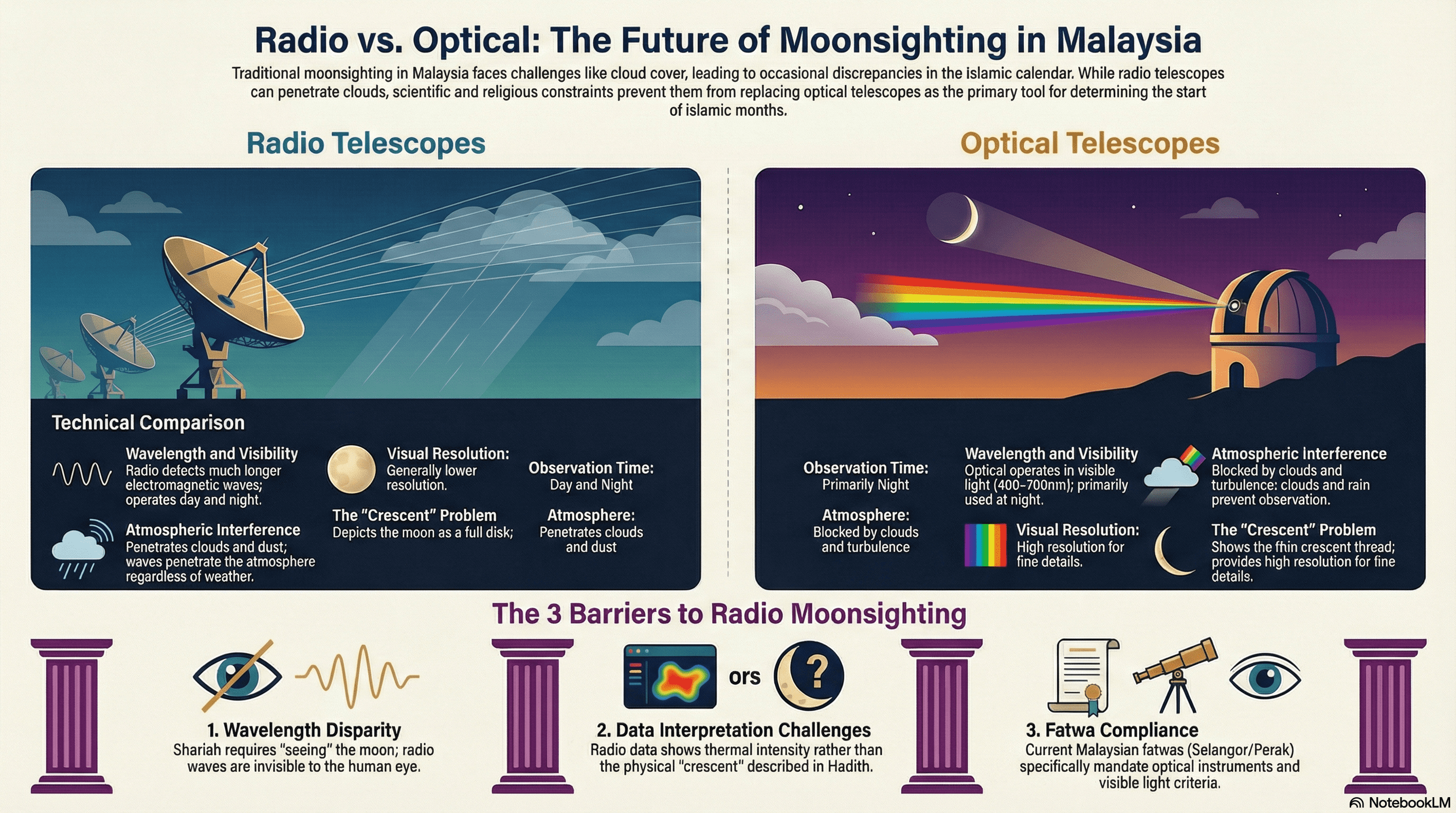
The moon, or "luna" in Latin, holds significant cultural and religious importance, serving as a natural calendar for various societies throughout history. In Islam, the new moon, specifically the first visible crescent, plays a crucial role in determining important events like Ramadan, Eid al-Fitr, and pilgrimage. However, traditional methods of moon sighting face challenges such as cloudy weather conditions and rain. This study aims to explore the potential use of radio telescopes as an alternative tool for hilal observation in Malaysia. For that, a qualitative method has been used, which involves interviewing experts, doing library research, comparing optical and radio telescopes through the lens of science, and then analysing from a syariah perspective. The study found that radio telescopes cannot be used as the main method in hilal observation. This is due to three main reasons preventing the use of radio telescopes in Malaysia: wavelength disparities, challenges in interpreting radio telescope data, and influential fatwa decisions favouring optical instruments. Even though radio telescopes are not permitted to be used as the primary method for determining the hilal, they can still be used as support data, enhance the precision of hilal observation, and aid in improving the accurate calculation and criteria for the determination of the beginning of Islamic lunar months. Therefore, further discussion and research to enhance the accuracy of hilal observation by using a radio telescope need to be developed.
Downloads