REFORMULATING PARENTAL RESPONSIBILITY IN CHILDREN’S CASH ON DELIVERY(COD) TRANSACTIONS UNDER INDONESIAN LAW
DOI:
https://doi.org/10.27526/xxx6ts04الملخص
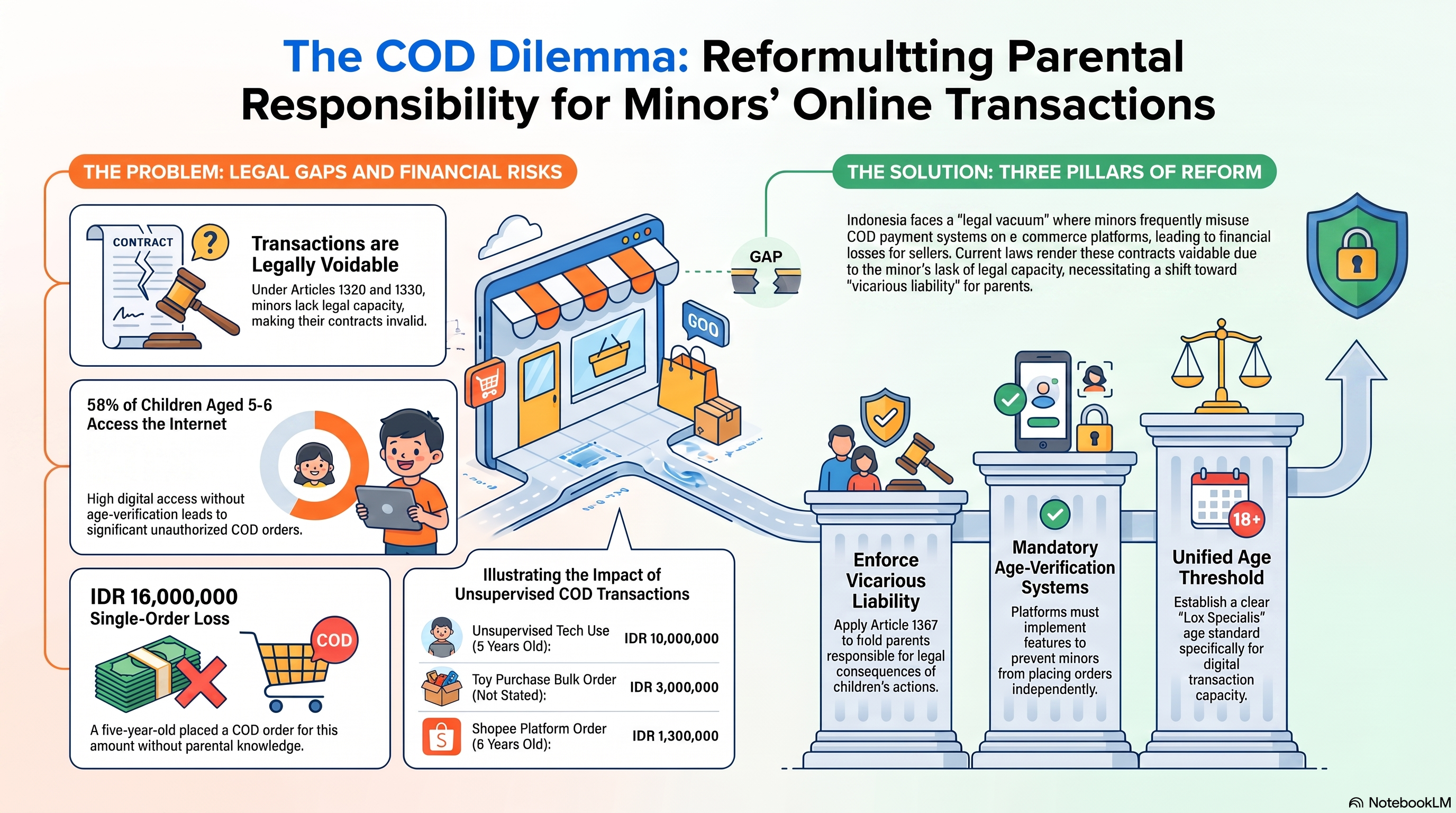
This article aims to examine and address various legal issues concerning online transactions conducted through the Cash on Delivery (COD) system, which have increasingly been carried out by minors and have resulted in losses for business actors. This situation arises due to the absence of age-verification features on e-commerce platforms, thereby allowing minors to place orders without parental supervision. The analysis demonstrates that transactions conducted by minors give rise to legal consequences in the form of voidable contracts and are deemed invalid for failing to meet the requirement of legal capacity, as stipulated in Articles 1320 and 1330 of the Indonesian Civil Code (Kitab Undang-Undang Hukum Perdata). This position is consistent with the Shāfiʿī school of Islamic jurisprudence, which holds that transactions conducted by a child who has not yet attained puberty (baligh) are legally invalid. Similarly, Malaysian law recognizes the doctrine of vicarious liability, although there is currently no specific regulation governing COD transactions. Nevertheless, in order to prevent such practices and to provide legal protection for all parties involved, Indonesia, as a welfare state, is obligated to address this legal vacuum by formulating specific regulations on parental responsibility in relation to online COD transactions. This approach is in line with Article 1367 of the Indonesian Civil Code, Islamic legal principles, and comparative insights from Malaysian law, which impose parental liability for the legal consequences arising from the acts of their children. Furthermore, there is an urgent need to establish a clear standard of legal capacity based on age for engaging in digital transactions, to impose parental responsibility for acts committed by minors, and to affirm the obligation of all e-commerce platforms to implement consumer age-verification systems.
التنزيلات
المراجع
Bukhari & Muslim. (n.d.). Kitab al-Imarah.
Rahardjo, S. (2000). Ilmu hukum. Bandung: Citra Aditya Bakti.
Rasjidi, L., & Wyasa Putra, I. B. (2003). Hukum sebagai suatu sistem. Bandung: Remaja Rosdakarya.
Titmuss, R. (1958). Essays on the welfare state. London: Allen & Unwin.
Kitab Undang-Undang Hukum Perdata. (n.d.).
Undang-Undang Republik Indonesia Nomor 8 Tahun 1999 tentang Perlindungan Konsumen. (1999).
Undang-Undang Republik Indonesia Nomor 23 Tahun 2006 tentang Administrasi Kependudukan. (2006).
Undang-Undang Republik Indonesia Nomor 11 Tahun 2008 tentang Informasi dan Transaksi Elektronik. (2008).
Undang-Undang Republik Indonesia Nomor 35 Tahun 2014 tentang Perlindungan Anak. (2014).
Undang-Undang Republik Indonesia Nomor 19 Tahun 2016 tentang Informasi dan Transaksi Elektronik. (2016).
Peraturan Menteri Perdagangan Republik Indonesia Nomor 50 Tahun 2020 tentang Ketentuan Perizinan Usaha, Periklanan, Pembinaan, dan Pengawasan Pelaku Usaha dalam Perdagangan Melalui Sistem Elektronik. (2020).
Contracts Act 1950. (1950).
Civil Law Act 1956. (1956).
Age of Majority Act 1971. (1971).
Consumer Protection Act 1999. (1999).
Consumer Protection (Electronic Trade Transaction) Regulations 2024. (2024).
Mihardja, A., Kurniawan, C., & Anthony, K. (2020). Vicarious liability: Perspektif masa kini. Jurnal Education and Development, 8(1).
Miftahussurur, W., & Aisyah, S. (2024). Pembayaran sistem COD perspektif syariah. Lex Economica Journal, 2(2).
Oktalisa, F. (2025). Perlindungan hukum terhadap pelaku usaha dalam perjanjian jual beli online yang dilakukan dengan anak di bawah umur melalui sistem pembayaran Cash On Delivery (Tesis S2). Universitas Andalas.
Kominfo Digital. (2025). Komitmen pemerintah melindungi anak di ruang digital. Diakses 19 September 2025, dari https://www.komdigi.go.id/berita/artikel/detail/komitmen-pemerintah-melindungi-anak-di-ruang-digital
Kumparan.com. (2021). Viral lalai awasi anak main HP, paket COD terus berdatangan hingga senilai Rp 16 juta. Diakses 8 Juli 2021, dari https://kumparan.com
التنزيلات
منشور
إصدار
القسم
الرخصة
الحقوق الفكرية (c) 2026 nurul aprianti, Andi Aulia Berliana, Lely Anggreni

هذا العمل مرخص بموجب Creative Commons Attribution-NonCommercial-ShareAlike 4.0 International License.