EXAMINING MAISIR ELEMENTS IN THE CRYPTO WORLD: IMPLICATIONS OF INDONESIA’S MUI FATWA NO. 1 OF 2022
DOI:
https://doi.org/10.27526/m5e1w362Keywords:
Cryptocurrency, maisir, Bitcoin, MUI Fatwa No. 1 of 2022, Islamic financeAbstract
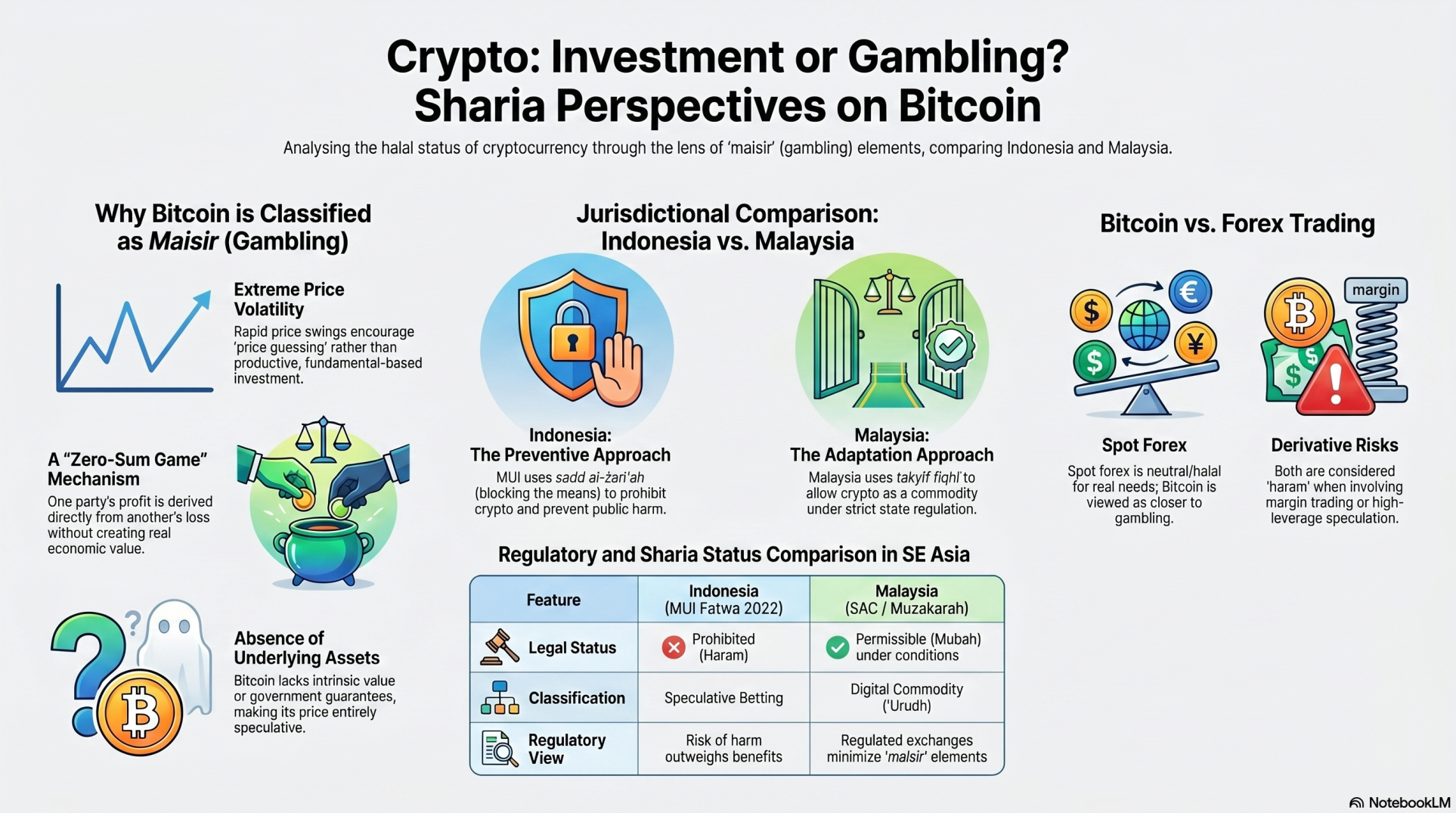
The rapid expansion of cryptocurrency as a global financial instrument has raised significant concerns among Islamic legal authorities, particularly regarding the presence of maisir (gambling), gharar (excessive uncertainty), and dharar (harm) in its mechanisms. This article examines the status of Bitcoin and similar digital assets in light of MUI Fatwa No. 1 of 2022, which classifies cryptocurrency as prohibited when used as currency or as a speculative investment lacking underlying value. Through a qualitative analysis of fatwas, regulatory frameworks, and comparative literature from Indonesia and Malaysia, the study identifies fundamental reasons behind the categorization of cryptocurrency—especially Bitcoin—as containing elements of maisir, notably extreme price volatility, speculative trading behavior, and the absence of intrinsic or asset-backed value. The paper further compares Bitcoin to forex trading, highlighting distinctions in risk structure, underlying assets, and sharia contract compliance. While spot forex may be permissible under the al-ṣarf contract when conducted for legitimate exchange purposes, margin-based or derivative forex instruments are classified as haram due to speculative and riba-based elements. In contrast, Bitcoin predominantly operates within a speculative framework that resembles a zero-sum game, thereby meeting maisir criteria. A comparative analysis with Malaysia’s Muzakarah Council and Shariah Advisory Council reveals a more accommodative regulatory stance, allowing cryptocurrency under strict supervision and platform licensing. Malaysia’s conditional permissibility approach contrasts with Indonesia’s prohibitive stance yet reflects a shared objective: minimizing public harm and preventing gambling-like practices in digital finance. The study concludes that, under current market conditions, Bitcoin investment as practiced widely today aligns strongly with maisir and is therefore prohibited according to MUI. Nevertheless, technological and regulatory developments—particularly asset-backed digital tokens and improved governance—may influence future sharia assessments. This suggests a dynamic interpretative space in which Islamic legal reasoning continues to engage with evolving financial innovations.
Downloads
References
Alias, M. A. A., Mohd Jailani, M. R., Wan Ismail, W. A. F., & Baharuddin, A. S. (2024). The integration of five main goals of shariah in the production of science and technology for human well-being. AL-MAQASID: The International Journal of Maqasid Studies and Advanced Islamic Research, 5(1), 1–16.
Bank Indonesia. (2011). Law of the Republic of Indonesia Number 7 of 2011 concerning currency. Bank Indonesia.
Commodity Futures Trading Supervisory Agency. (2019). BAPPEBTI Regulation No. 5 of 2019 concerning technical provisions for the implementation of the physical market for crypto assets on the futures exchange. Ministry of Trade of the Republic of Indonesia.
Fetraningtyas, I. D., & Yunanto, Y. (2020). The prohibition of maisir, gharar, riba in Islamic economic transactions. Journal of Sharia Economics, 8(2), 123–135.
Mamat, Z., Wan Ismail, W. A. F., Abdul Mutalib, L., Hashim, H., & Baharuddin, A. S. (2025).Penerimaan jawatankuasa fatwa negeri terhadap keputusan hukum produk halal oleh Muzakarah Majlis Kebangsaan bagi Hal Ehwal Agama Islam (MKI). LexForensica: Forensic Justice And Socio-Legal Research Journal,2(1), 19-34. https://doi.org/10.33102/pseaa963
Mohd. Zain, N. R., & Hasan, A. . (2021). Ar-rahnu: Isu dan penyelesaian semasa. Malaysian Journal of Syariah and Law, 9(1), 47-60.
Muzakarah Committee of the National Council of Malaysia. (2020). Results of the 117th MKI Muzakarah: The law of cryptocurrencies. JAKIM.
National Sharia Council-MUI. (2002). DSN-MUI Fatwa No. 28/DSN-MUI/III/2002 on the buying and selling of currency (al-sharf). DSN-MUI.
Sacipto, R., Yasin, A., & Syah, A. F. (2023, May). Government role analysis: Cryptocurrencies review of theory, Islamic law and policy in Indonesia. In Proceeding of International Conference on Education, Society and Humanity (Vol. 1, No. 1, pp. 871–883).
Securities Commission Malaysia – Shariah Advisory Council. (2020). Resolutions of the Shariah Advisory Council: Digital assets from Shariah perspective. Securities Commission Malaysia.
Zulkifli, M. A. (2018). Bayan Linnas 153rd Series: Legal use of the Bitcoin currency. Office of the Mufti of the Federal Territories.
Downloads
Published
Conference Proceedings Volume
Section
License
Copyright (c) 2026 Amanda Razita Ghaisani, Anasassa Fino Masamba, Piami Sarah

This work is licensed under a Creative Commons Attribution-NonCommercial-ShareAlike 4.0 International License.